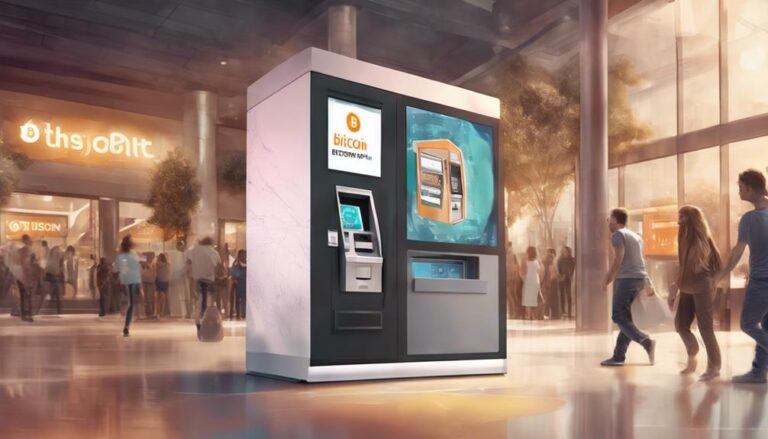
A Bitcoin ATM shows you its exchange rate before you feed in a single dollar, but the screen buries it between logos and QR codes, and most people tap through without reading it. The Federal Reserve Bank of Kansas City reported in 2023 that every legitimate machine discloses its rate on screen during the transaction flow, even when the operator publishes nothing about pricing anywhere else. That disclosure is the only number that matters. The trick is knowing where to find it and how to turn it into a figure you can actually compare against what Bitcoin is worth at that moment.
Where the rate shows up on the screen
After you select “buy” and enter a phone number for verification, most machines walk you through three or four screens before asking for cash. Somewhere in that sequence, usually right before the cash slot lights up, the machine will display either a flat exchange rate (“1 BTC = $X”) or a breakdown showing how much Bitcoin you’ll receive per dollar inserted. Some machines show this as a running total that updates as you feed in bills. Others show it as a single locked-in quote once you confirm the transaction amount.
Read that number before you put in a single bill. It’s the only piece of information the machine gives you that lets you calculate what you’re actually paying, as opposed to what the operator advertises. If a machine skips this step entirely, or the screen is blank where the rate should be, that’s a reason to stop and walk to a different machine rather than assume it’ll show up later.
The math: cash in versus coin out
The advertised fee percentage, if the operator lists one at all, is not the same as your effective rate. The effective all-in rate is measured by comparing the cash you paid against the market value of the coin you actually received at that moment, not by reading the advertised fee alone.
Here’s how to do that math standing at the machine. Say Bitcoin is trading at 100,000 dollars at that moment — use whatever the real number is when you’re standing there, this is just an example to show the arithmetic. You put in 200 dollars. The machine’s screen tells you it will send you 0.0018 BTC.
At the real market price of 100,000 dollars per coin, 0.0018 BTC is worth 180 dollars. You paid 200 dollars for something worth 180 dollars. That’s a 20-dollar gap, or 10 percent of what you put in. That 10 percent is your effective rate for this transaction — it already includes the operator’s markup and any exchange rate padding baked into the machine’s quoted price. You don’t need to know the operator’s advertised fee schedule to get this number. You just need the market price of Bitcoin at that exact moment (check it on your phone before you approach the machine) and the amount of BTC the screen says it will send you.
Do this calculation before confirming, not after. If the machine only shows you a locked rate after cash is already in the slot, do the math on the confirmation screen and abandon the transaction there if the numbers don’t work for you.
Why the advertised number is probably worse than it looks
If a machine does publish a fee percentage, treat it as a floor, not a ceiling. The Federal Reserve Bank of Kansas City found the median self-reported buy fee across US Bitcoin ATMs is 16 percent of transaction value, with a median sell fee of 15 percent. Exchange rate costs add an estimated 5 to 7 percent on top of that, and the same report notes that total fees of 20 percent may not be uncommon once both are combined.
That 16 percent median is self-reported by operators through Coin ATM Radar, and operators charging above-average rates commonly disable that reporting. So the published median is biased low — the real spread you’ll encounter at machines that don’t self-report is likely higher, not lower, than 16 percent. This matters because the total cost of actually running a Bitcoin ATM — cash logistics, compliance, connectivity, physical security — is estimated at only 3 to 6 percent of revenue. The gap between that operating cost and a 16 to 20 percent fee is margin, not overhead. When you see a quoted rate that implies a 25 or 30 percent gap between cash-in and coin-out, you’re not covering the operator’s costs. You’re covering their profit, several times over.
The point at which you can still walk away
A transaction can be abandoned at the machine before cash is inserted. This is the single most useful fact in this entire process, because it means every screen before the cash slot is a free look. You can enter your phone number, select an amount, watch the rate populate, do the math above, and cancel out with nothing lost if the number doesn’t work for you.
Once cash goes in and the machine dispenses coin to your wallet, that’s final. Bitcoin transactions are irreversible once confirmed, so there’s no chargeback, no dispute process, no calling a bank to reverse the charge. If you realize after the fact that you paid a 28 percent effective rate, there is no mechanism to claw any of that back. The entire leverage you have as a customer exists in the seconds before you feed in cash. Use it.
This is also the moment to think about who is operating the machine at all. US Bitcoin ATM operators are money services businesses subject to federal anti-money-laundering obligations, and money transmitter licensing is handled state by state — meaning the legal framework varies depending on where you’re standing, and a machine’s compliance posture isn’t something you can verify on the spot. What you can verify on the spot is the rate. Do that, and treat everything else as a reason to be cautious rather than a reason to trust the machine automatically.
Before you go
Machines close, get repossessed, or go dark without much notice. Bitcoin Depot filed for Chapter 11 bankruptcy in May 2026, and more than 9,000 of its machines were deactivated as a result — a reminder that a listing you find online today may not reflect a working machine tomorrow. USA Crypto Reports checked 200 Bitcoin ATM listings directly and found that 41 of them, roughly one in five, no longer existed at the location listed. Before you drive somewhere specifically to use a machine, confirm it’s still active rather than relying on an address alone. If a term on the confirmation screen doesn’t make sense — “network fee,” “spread,” “locked rate” — look it up in the site glossary before you commit cash, not after.
Check our verified Bitcoin ATM directory for a machine near you, and if you show up to one that’s been removed or relocated, report a machine that has closed or moved so the next person doesn’t waste a trip. Then, standing at whichever machine you actually use, pull up Bitcoin’s price on your phone, read the rate on the confirmation screen, do the subtraction, and only put cash in once the gap between what you’re paying and what you’re getting is a number you’re willing to accept.