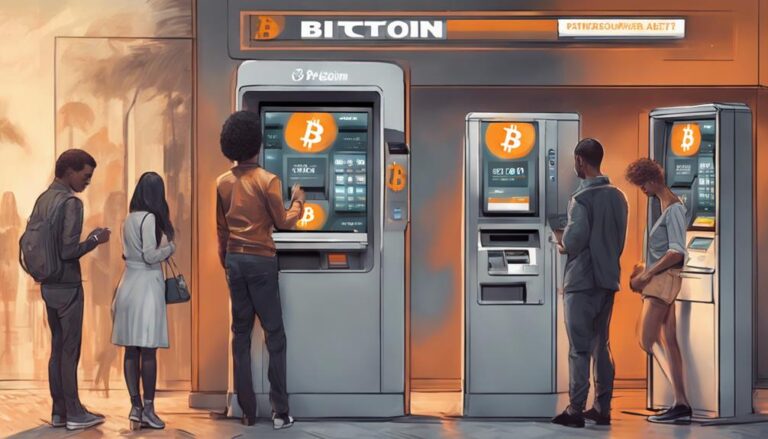
A Bitcoin ATM that sells you coins usually hands over a receipt in seconds. A machine that lets you sell Bitcoin for cash, though, will often make you wait several minutes before the bills come out. That wait isn’t a glitch or a stalling tactic. It’s the machine checking that your transaction actually made it onto the Bitcoin network before it parts with its cash drawer.
What a block actually is
Bitcoin doesn’t have a bank sitting in the middle keeping a private ledger. Instead, every transaction gets bundled into a group called a block, and that block gets added to a public chain of previous blocks. Once your transaction is included in a block, it’s confirmed. Every block added after that one counts as another confirmation, because it becomes progressively harder to undo.
New blocks show up roughly every ten minutes on average, though that interval isn’t fixed. Sometimes a block appears in two minutes, sometimes it takes twenty-five. Miners around the world are competing to solve a computational puzzle, and nobody controls exactly when the next one lands. That average is a network-wide statistic, not a promise about your specific transaction.
If you’re new to terms like this, the site’s glossary breaks down blocks, confirmations, and related terms in plain language.
Why one confirmation is usually fine for a small buy
If you’re buying a small amount of Bitcoin at a one-way machine, the operator is the one taking on risk, not you. They’re sending you coins in exchange for your cash, and once that transaction is confirmed once, it’s extremely unlikely to be reversed or replaced by a competing transaction. For a modest purchase, most operators consider one confirmation enough proof that the transaction is settled and won’t second-guess it further. The machine prints your receipt and you’re done, typically within the time it takes for the network to find that next block.
The math changes with the size of the transaction and, more importantly, with who’s on the hook if something goes wrong. That’s the real reason two-way machines behave differently.
Why a two-way machine won’t hand over cash right away
A two-way Bitcoin ATM does two things: it sells you Bitcoin, and it buys Bitcoin from you for cash. When you’re selling, you send Bitcoin to the machine’s wallet, and the machine is now the party receiving funds. That’s the crucial detail. Waiting for confirmations protects whoever is receiving the funds against the transaction being replaced or simply not settling at all. Since the machine is the receiving party in a cash-out transaction, it waits before it releases anything from its cash dispenser.
Put yourself in the machine’s position for a second. You send it Bitcoin, it hasn’t confirmed yet, and the machine spits out cash immediately. If that transaction never confirms, or gets replaced by a different version before it’s locked into a block, the machine operator has just given away cash for nothing. Bitcoin transactions are irreversible once confirmed, which is exactly why operators are careful before that point. There’s no chargeback mechanism to fall back on the way there is with a credit card. Once the money’s out the slot and the transaction never finalizes, the operator has no recourse. So the machine waits for at least one confirmation, and for larger cash-out amounts, it may wait for several, precisely because there’s no way to claw the cash back afterward.
What this means for your wait time at the machine
In practice, this means a cash-out transaction at a two-way kiosk can take anywhere from a few minutes to considerably longer, depending on how many confirmations the operator requires and how quickly blocks happen to be found that day. There’s no way to speed this up by tapping the screen repeatedly or restarting the transaction. The network processes at its own pace, and the machine is simply following its own security policy on top of that pace.
This waiting period is also worth keeping in mind alongside the actual cost of using these machines. The Federal Reserve Bank of Kansas City reported in 2023 that the median fee for buying Bitcoin from a US Bitcoin ATM, based on operators’ own reporting to Coin ATM Radar, was 16 percent of the transaction value, with a median sell fee of 15 percent. On top of that, the same report estimated that exchange rate costs add another 5 to 7 percent, meaning total fees of 20 percent may not be unusual for a single transaction. That’s a striking figure next to the Federal Reserve Bank of Kansas City’s estimate that it costs operators only 3 to 6 percent of revenue to actually run one of these machines. The gap between what operators charge and what it costs them to operate is wide, and it’s worth remembering that the 16 percent figure is self-reported, with operators charging above-average rates commonly opting out of reporting altogether, which means the real median fee across the industry is likely higher than published.
None of that is a reason to distrust the confirmation wait itself. Waiting for the network to confirm your transaction is a legitimate security measure, not a way for the operator to extract extra time or money from you. But it’s a reminder that the fee structure and the wait time are two separate costs of using these machines, and both are worth weighing before you use one for a large amount.
Before you use a machine, check that it’s still there
Bitcoin ATMs close, move, or get switched off more often than most users expect. USA Crypto Reports verified 200 Bitcoin ATM listings across various directories and found that 41 of them, roughly one in five, no longer existed at the listed location. On a larger scale, Bitcoin Depot filed for Chapter 11 bankruptcy in May 2026, and more than 9,000 of its machines were deactivated as a result. If you show up expecting a working kiosk and it’s gone, that’s a wasted trip at best.
It’s also worth remembering that these machines aren’t unregulated street corners. US Bitcoin ATM operators are classified as money services businesses and are subject to federal anti-money-laundering obligations, with money transmitter licensing handled state by state. That doesn’t eliminate risk, but it means there’s a paper trail and a regulatory framework behind legitimate operators, which is one more reason to stick to machines and operators you can actually verify.
Before you drive out to use a two-way Bitcoin ATM, check our verified Bitcoin ATM directory to confirm the machine is still active at that address, and if you find one that’s closed or moved, report a machine that has closed or moved so the next person doesn’t waste their trip.