What Does Cryptography Mean for Cryptocurrency Privacy?

When you think about cryptocurrency, you might not immediately consider the crucial role that cryptography plays in maintaining your privacy. Yet, it's the backbone of securing your digital assets from prying eyes and malicious actors. By encrypting data and generating unique public and private keys, cryptography allows you to execute transactions with confidence, knowing your information remains confidential. But how secure is this system really? As you explore the intricate balance between accessibility and privacy, you'll find that the answer isn't as straightforward as it might seem, leading to ongoing debates and developments that could reshape the future of digital currency security.
Understanding Cryptography Basics

At the heart of securing digital transactions, cryptography provides the essential tools you need to maintain privacy in cryptocurrency. It's the science of encoding and decoding information, ensuring that your transactions remain confidential and tamper-proof. You might wonder how this works in the realm of digital currencies like Bitcoin or Ethereum.
Cryptography in cryptocurrency utilizes complex algorithms and mathematical principles. Two primary components are hash functions and digital signatures. A hash function helps verify the integrity of data, converting input information into a fixed-size string of characters, which appears random. It's what ensures each block in a blockchain is unique and secure.
Digital signatures, on the other hand, prove the ownership of a transaction. When you make a transaction, you sign it with your private key, which is then verifiable by others using your public key. This process confirms that you're the sender of the digital currency without revealing your private key to the public.
Understanding these basics helps you grasp how your digital assets are protected. Cryptography doesn't just secure transactions; it's the backbone of the trust and security in the cryptocurrency ecosystem. As you dive deeper, you'll appreciate the elegance and necessity of these cryptographic systems in your digital transactions.
Role of Encryption in Transactions
Understanding cryptography basics sets the stage for exploring how encryption directly impacts the security and privacy of your transactions. Essentially, encryption transforms the readable data associated with your cryptocurrency transactions into a secure format that only authorized parties can access and read. This is crucial because every transaction you make on the blockchain is visible to everyone, but encryption ensures that the details remain confidential.
When you initiate a transaction, your transaction data, including your public key, is encrypted with a cryptographic algorithm before it's broadcast to the network. This process, known as public key encryption, helps protect your information from unauthorized access while maintaining the integrity of the transaction.
Moreover, encryption doesn't just secure data in transit; it also safeguards data at rest. Your digital wallet, which stores your private keys, employs robust encryption methods to prevent outsiders from accessing your funds without your permission. This layer of security is vital, considering the irreversible nature of cryptocurrency transactions.
Anonymity Versus Pseudonymity

When discussing privacy in cryptocurrency, it's essential to distinguish between anonymity and pseudonymity. You might think they're the same, but they serve different roles in protecting your identity.
Anonymity means you're completely unidentifiable within a transaction. No one knows who you are, and there's no trace leading back to you. It's like walking into a room, interacting, and leaving without anyone ever knowing your name or even recognizing your face.
In the realm of cryptocurrency, achieving true anonymity is challenging due to the underlying technology that often requires some trail of transactions.
On the other hand, pseudonymity allows you to operate under a fictitious name or address. In the crypto world, this is typically your public address. You can conduct transactions, but they're tied to this identifier rather than your real identity. However, if someone connects your pseudonym to your actual identity, your activities could be traced back to you.
Both concepts are crucial in the context of digital currencies. They protect users from undue scrutiny and enhance personal freedom. Yet, they also create avenues for misuse, making it a double-edged sword.
As you dive deeper into cryptocurrency, you'll see how pivotal these features are to your privacy strategy.
Enhancing Security With Hash Functions
Building on the foundation of anonymity and pseudonymity in cryptocurrency, hash functions significantly bolster your security. These mathematical algorithms process your data into a fixed-size output, a "hash," which is unique to each input. If you alter the data even slightly, you'll get a completely different hash, highlighting any tampering attempts.
Hashing is crucial because it ensures that the data stored in the blockchain remains unaltered and authentic. Every transaction you make is hashed, and these hashes are then linked together in the blockchain. This linkage creates a secure and unbreakable chain because to alter one hash, an attacker would need to alter all subsequent hashes, which is computationally impracticable.
Moreover, hash functions are designed to be one-way operations. You can easily generate a hash from an input, but it's nearly impossible to deduce the original input from its hash. This ensures that your data can't be reverse-engineered, safeguarding your sensitive information from prying eyes.
This layer of security is transparent but robust, working silently in the background to protect your transactions and maintain the integrity of the entire cryptocurrency network. You're not just conducting transactions; you're weaving your activity into an indelible blockchain fabric.
Impact of Public and Private Keys
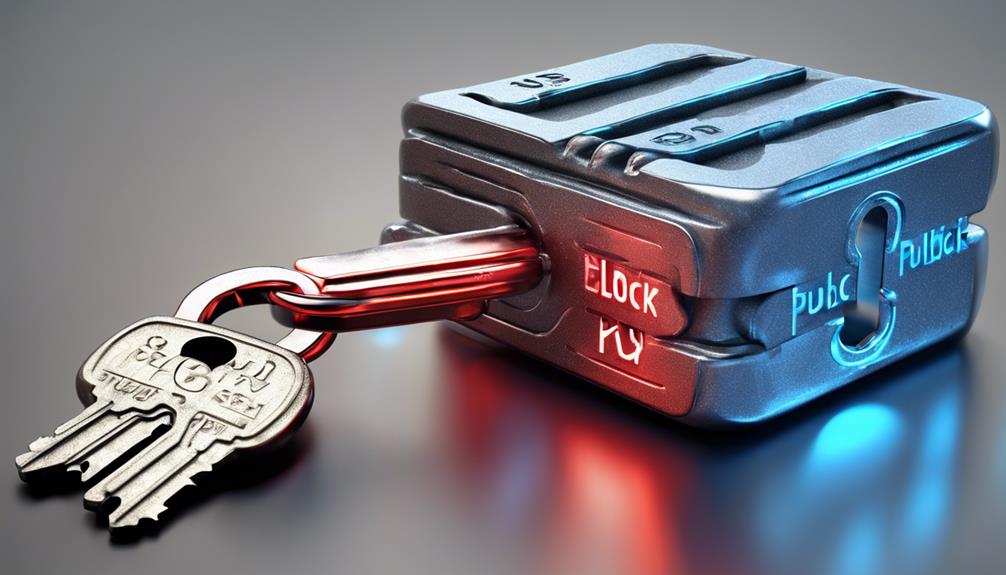
You'll encounter public and private keys as crucial elements in cryptocurrency transactions, each serving distinct roles. Here's how they impact your privacy.
The public key, derived from your private key, acts like a mailbox. Anyone can drop a message in, but only someone with the private key can open it. This setup ensures that while your transaction details are visible on the blockchain, your identity remains obscured, tethered not to your personal details but to a cryptographic code.
Your private key, however, is akin to the key to that mailbox. It's what you use to access and control your cryptocurrencies. If someone else gets their hands on your private key, they can control your funds as if they were theirs. This underscores the necessity of keeping your private key secure, as its exposure can lead to loss or theft of your assets.
Moreover, while the public key can be shared without compromising your security, the private key must remain confidential. This distinction is essential for maintaining both the integrity and privacy of your transactions. By understanding and managing these keys wisely, you bolster your control over your digital assets and your transactional privacy.
Cryptographic Protocols in Blockchain
Understanding public and private keys provides a solid foundation for exploring cryptographic protocols used in blockchain technology. When you delve into blockchain, you're not just looking at digital transactions, but a robust system that ensures these transactions are secure, private, and immutable.
One fundamental protocol in blockchain is the consensus protocol, such as Proof of Work (PoW) or Proof of Stake (PoS). These protocols help maintain the integrity and agreement of the blockchain network on the state of the ledger. You're not only observing transactions being verified but also seeing how new blocks get added securely.
Moreover, cryptographic hashing plays a critical role. Every block in the blockchain is identified by a cryptographic hash of its contents, linking it securely to the previous block and creating a chain. This makes it nearly impossible to alter any aspect of the blockchain without detection.
Encryption methods also protect the data in the transactions, keeping your information confidential. Each transaction is linked to the blockchain using complex algorithms that ensure only the sender and the intended receiver can view or access the transaction details.
These cryptographic protocols are what make blockchain an exceptionally secure technology, ensuring that your cryptocurrency dealings are both private and protected.
Challenges in Cryptographic Implementations

Despite the robust security features of cryptographic protocols, frequently, the actual implementation poses significant challenges. As you dive into the world of cryptocurrency, you'll quickly learn that the theoretical strength of any cryptographic approach doesn't always translate seamlessly into practice. One significant hurdle is human error. Developers, under pressure and tight deadlines, might inadvertently introduce bugs that compromise security. These errors can make systems vulnerable to attacks that exploit such weaknesses.
Additionally, the complexity of cryptographic code can lead to implementation flaws. Cryptography demands precision, and even the smallest error in algorithm implementation can leave an opening for security breaches. You've got to stay vigilant, as attackers are always on the lookout for any chink in the armor.
Another challenge you'll face is ensuring cryptographic agility. The ability to adapt and upgrade cryptographic measures is crucial as technology and attack methodologies evolve. However, updating cryptographic features can be cumbersome, and maintaining compatibility across different systems exacerbates the issue.
Future Trends in Crypto Privacy
As we look to the future, expect significant advancements in crypto privacy technologies. You'll see emerging solutions that aim to strengthen your transactional secrecy without compromising the integrity of the blockchain. Developers are already hinting at more robust protocols that integrate zero-knowledge proofs (ZKPs) more deeply. These protocols ensure that you can verify transactions without exposing any underlying data.
You should also keep an eye on advancements in multi-party computation (MPC). This technology will allow you to perform joint operations on data with others without needing to reveal your individual inputs. It's a game-changer for maintaining privacy in collaborative environments.
Additionally, the rise of decentralized finance (DeFi) platforms is pushing the envelope on privacy. Expect to see privacy-centric features becoming standard, mitigating risks of data exposure. These platforms are likely to adopt new cryptographic methods that mask asset movements while ensuring compliance with regulatory frameworks.
Conclusion
In conclusion, you'll find that cryptography is indispensable for maintaining privacy in cryptocurrency transactions. It not only shields your transaction details through encryption and hash functions but also ensures your identity stays protected, whether you opt for anonymity or pseudonymity. By leveraging public and private keys, and evolving cryptographic protocols, you're set for a secure digital transaction experience. However, keep an eye on emerging challenges and trends to stay ahead in safeguarding your crypto assets.