What Drives Crypto Mining’s Massive Energy Use?
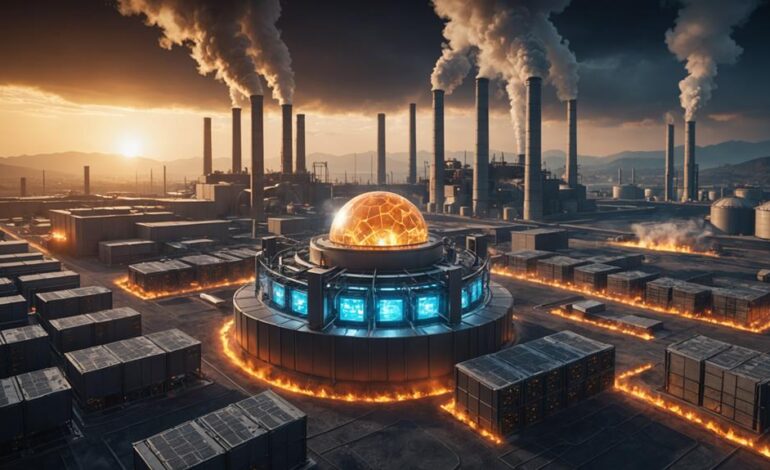
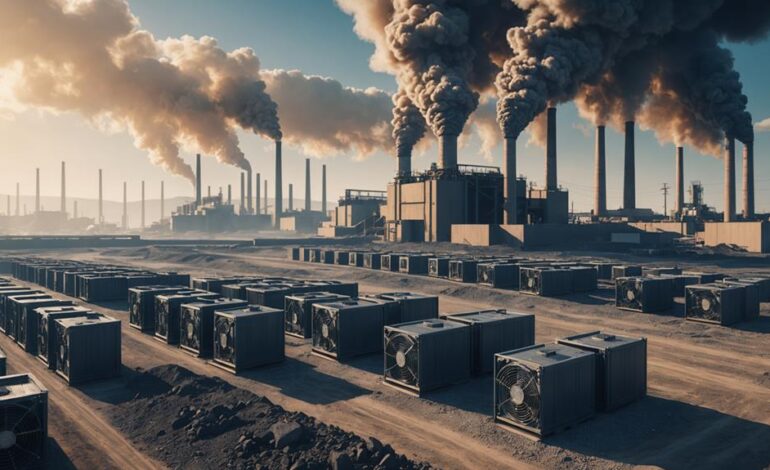
You've likely heard about the staggering energy consumption of crypto mining, but have you ever wondered what really fuels this digital gold rush? At the heart of it all is the Proof of Work algorithm, demanding miners to solve cryptographic puzzles, a process that isn't just complex, but incredibly power-hungry. As you explore the layers of this issue, consider not only the specialized hardware like ASICs and GPUs but also the global chase for the cheapest power sources. What might surprise you is the intricate balance between technological advancement and environmental impact. Let's unpack the factors that keep this energy-hungry beast running.
Understanding Proof of Work
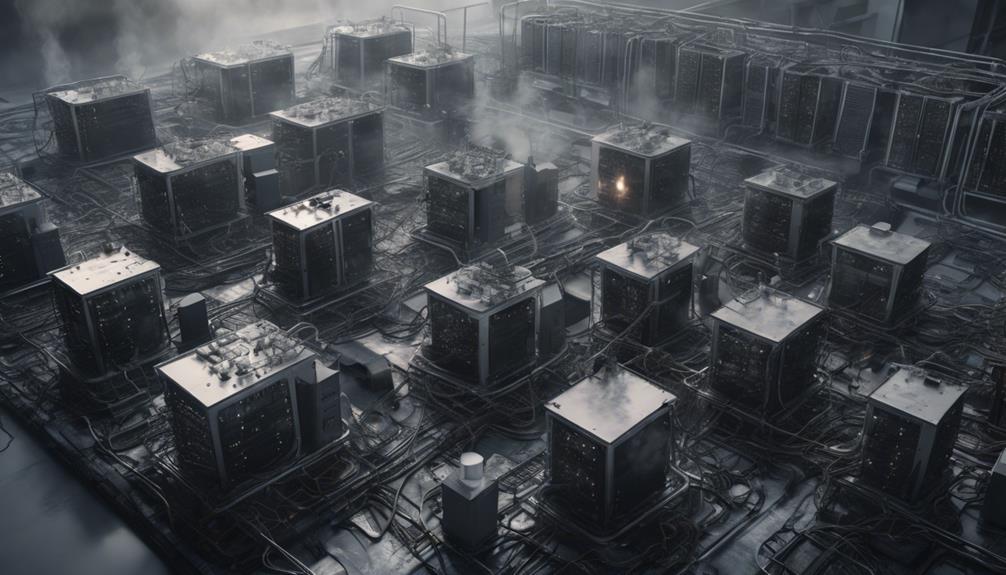
Proof of Work (PoW) is a fundamental concept that forms the backbone of many cryptocurrencies, including Bitcoin. You've likely heard of Bitcoin mining; that's PoW in action. Essentially, it requires participants, called miners, to solve complex mathematical puzzles to validate transactions and secure the network. This mechanism aims to deter malicious activities by making attacks costly.
When you send or receive Bitcoin, your transaction joins others in a "block" to be verified by miners. They use powerful computers to compete in solving the puzzle first. The winner updates the blockchain with the verified block and earns new bitcoins as a reward. This competitive process ensures the network remains decentralized and secure.
However, it's not just about solving puzzles. The PoW system also synchronizes the network, making sure all transactions are recorded without issues and in the right order. This prevents fraud, such as double-spending the same bitcoin.
Understanding PoW helps you grasp why mining is more than just creating new coins. It's about maintaining a trusted and reliable system. You see, without PoW, the decentralized nature of cryptocurrencies wouldn't be possible. It's the engine under the hood, keeping the digital currency running smoothly.
Mining Hardware Energy Requirements
As you've learned, the Proof of Work system relies heavily on high-performance computing power to solve mathematical puzzles and secure cryptocurrency networks. This power isn't just any old desktop power; we're talking about specialized hardware like ASICs and GPUs. These aren't just power-hungry; they're ravenous.
You might wonder just how much energy these machines consume. Well, it's a lot. ASICs, or Application-Specific Integrated Circuits, are tailored to efficiently mine cryptocurrencies like Bitcoin. However, their efficiency comes at a cost of high electricity usage.
Similarly, GPUs, or Graphics Processing Units, are versatile but also consume a significant amount of power, especially when part of vast mining operations.
The energy demand scales up with the quest for quicker and more efficient mining hardware. The newer the hardware, the better its mining capability, typically, but this also means greater electricity consumption. This continuous upgrade cycle keeps pushing the energy requirement upwards.
Operating these machines 24/7, miners maximize their chances of earning cryptocurrency rewards but at the expense of an ever-increasing power bill. Each step towards more advanced hardware necessitates more energy, contributing substantially to the overall energy footprint of crypto mining. So, while the tech improves, the energy bill skyrockets.
Global Distribution of Mining Farms

Where are the world's crypto mining farms primarily located? You'll find the bulk of them in regions where two main factors converge: low-cost energy and relatively lenient regulatory environments. Initially, China dominated the scene, hosting over 75% of the global Bitcoin mining operations due to its cheap electricity and vast land. However, recent crackdowns on cryptocurrency activities have shifted the landscape dramatically.
Now, you're seeing a significant migration of mining operations to countries like the United States, Russia, and Kazakhstan. The U.S., for instance, has become increasingly attractive to miners because of its stable political climate, investment in renewable energy sources, and areas with naturally cool climates which reduce the need for extensive cooling infrastructure. Texas, with its deregulated power grid and cheap wind power, has become a hotspot.
Countries like Russia and Kazakhstan offer the dual advantages of vast, unused land and cheap power—often from fossil fuels—which, despite environmental concerns, continue to attract large-scale mining operations. This global shift is reshaping the dynamics of crypto mining, influencing everything from bitcoin's price to regional energy policies.
Cooling Systems in Mining Operations
Given the global dispersion of crypto mining operations, effective cooling systems have become a key focus in maintaining the longevity and efficiency of these high-energy data centers.
You'll find that as mining rigs run continuously, they generate immense heat, which if not properly managed, can lead to hardware failures and reduced efficiency.
You're dealing with two main types of cooling systems: air conditioning and liquid cooling. Air conditioning is more common and involves circulating cool air within the mining environment to dissipate heat. However, it's not always the most energy-efficient method, especially in warmer climates.
On the other hand, liquid cooling systems, which use water or other coolants to absorb heat, are gaining popularity. They're often more effective at heat removal, reducing the risk of overheating in your mining setups.
You should also consider the placement of cooling vents and the use of exhaust systems to optimize airflow. This isn't just about pumping cold air in; it's about strategically removing hot air to maintain an ideal operating temperature.
Trends in Cryptocurrency Mining Efficiency

With advancements in technology, cryptocurrency mining has become increasingly efficient. You've likely heard about the high energy costs associated with mining, but as you delve deeper, you'll find that the industry is adapting rapidly. Manufacturers are now designing mining hardware, like ASICs and GPUs, that not only pack more power but also use energy more judiciously.
You're seeing a significant shift towards the use of renewable energy sources in mining operations. Solar, wind, and hydroelectric power are becoming common sights at mining farms, especially in regions where these resources are abundant and cheap. This isn't just good for the planet—it also makes economic sense as it reduces dependency on volatile fossil fuel markets.
Efficiency is also being driven by improvements in mining algorithms. Developers are continuously refining the software to require less computational power to solve the puzzles that secure blockchain transactions. This not only cuts down on electricity usage but also extends the lifespan of mining equipment.
Moreover, the emergence of mining pools has optimized resource allocation. By joining forces, miners can share processing power, reducing redundant efforts and wasted energy. This collaborative approach maximizes output while minimizing the energy footprint, aligning with global trends towards sustainability in tech.
Conclusion
You've seen how the Proof of Work (PoW) algorithm, with its complex requirements, drives the huge energy use in crypto mining. The specialized hardware, like ASICs and GPUs, not only consume vast amounts of electricity but also need frequent upgrades and intense cooling to function efficiently. Moreover, the global spread of mining farms exploiting cheap energy exacerbates the situation. As you explore these dynamics, it's clear that improving mining efficiency remains a critical challenge in reducing the overall energy footprint.