Cryptocurrency, such as Bitcoin, is recognized by many countries, although the specific legal status varies substantially from one jurisdiction to another.
El Salvador stands out as the first country to adopt Bitcoin as legal tender.
Additionally, countries like the United States, where Bitcoin is legal and treated as a convertible currency or property for taxation purposes, and Australia, where it is considered legal and subject to capital gains tax.
Furthermore, France, Denmark, Germany, Japan, and several other countries permit its use, often with specific regulations and taxation guidelines.
Countries Legalizing Bitcoin

Several countries have embraced Bitcoin, recognizing and regulating its use as a legitimate form of currency.
In the United States, the Treasury defines Bitcoin as convertible digital currency with a real-value equivalence, making it a forward-thinking approach.
Across the pond, the United Kingdom takes pride in its regulated environment, governed by the Financial Services and Markets Act.
The European Union labels Bitcoin as a crypto-asset under the MiCA Regulation, ensuring clear regulations.
Canada's friendly attitude towards Bitcoin treats crypto transactions with respect and understanding.
Other countries where Bitcoin is legal include El Salvador, the Central African Republic, Japan, Mexico, Singapore, Saudi Arabia, and many others.
Nations Banning Cryptocurrency
The ban of cryptocurrency in several countries remains a pressing concern.
Algeria bans it under a 2018 financial law. Bolivia has a complete ban effective since 2014. Nepal also strictly prohibits the use of digital currencies, with severe penalties for non-compliance.
These countries aim to protect their economies by enforcing Anti-Money Laundering (AML) standards.
The legal status is clear: engaging with cryptocurrencies can lead to legal consequences.
Continuous adjustments to regulatory frameworks ensure financial integrity and prevent misconduct.
These measures are a testament to their commitment to safeguarding citizens and the financial market.
Global Crypto Regulations Overview
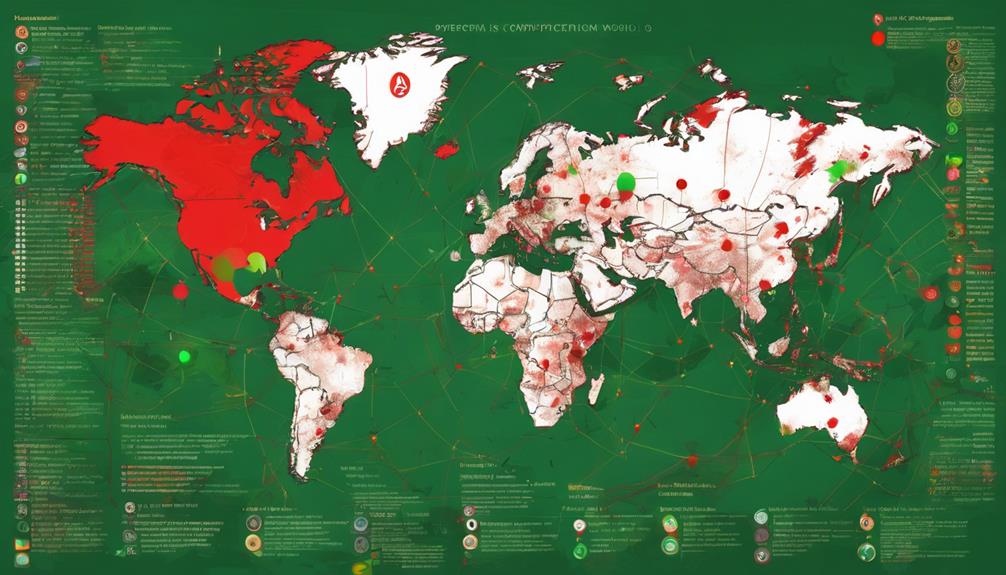
Global Crypto Regulations Overview
Across the globe, cryptocurrency legality varies widely.
Among the 130 countries surveyed, a significant majority—119 nations and 4 British Overseas Territories—have legalized cryptocurrency, with 64.7% of these being emerging and developing nations in Asia and Africa.
However, only 62 countries boast comprehensive regulations, reflecting a growing trend towards structured crypto governance.
This includes 36 individual countries, along with 22 in the European Union and 4 British Overseas Territories.
Each region tailors its regulations to meet unique economic and social needs, emphasizing the importance of local engagement.
Europe is at the forefront with 39 countries recognizing the validity of cryptocurrencies, closely followed by Asia with 35.
In the Americas, 24 countries have legalized digital currencies, while Africa trails with 17 of its 44 countries having done so.
This patchwork of acceptance and regulation underscores the need for understanding and integration of this technology into daily life, making local voices and participation crucial in shaping the future of finance.
Bitcoin as Legal Tender
In recent years, countries like El Salvador have adopted Bitcoin as official legal tender, a trend that presents both opportunities and challenges.
This bold move by Nayib Bukele, the President of El Salvador, might feel like a distant news item, yet it's part of a bigger wave you're also riding. Indeed, the adoption reflects a growing acceptance of cryptocurrencies as a valid form of payment worldwide.
Now imagine walking into a store in El Salvador or other places where Bitcoin isn't just an investment but an actual medium of exchange. You could pay for groceries or a coffee using Bitcoin, just as you might use the local currency, the U.S. dollar.
It's not only about being part of a futuristic wave; it's about experiencing belonging in a global digital community.
Even if you're in regions where Bitcoin hasn't been declared as legal tender, like Mexico, the influence of these pioneering countries might make you wonder about the potential shifts in your own backyard.
Using Bitcoin—or any cryptocurrency as a payment method—connects you not just to a store or a seller, but to a network of global users who also see the value in this new, digital form of currency.
Bitcoin Payment Legality

You can legally use Bitcoin for payments in several countries, including the United States and the United Kingdom.
In the U.S., it's recognized by the Treasury Department as a convertible currency, holding real value like traditional money. This means when you make a payment using Bitcoin, you're essentially using a recognized monetary substitute.
Across the pond in the UK, following the updated Financial Services and Markets Act in 2023, Bitcoin transactions also comply with specific regulatory frameworks, ensuring your digital transactions are as legitimate as handing over pounds.
Up north, Canada sees Bitcoin in a similar light, treating it as a crypto-asset. Whether you're buying goods online or paying for a service, remember that your Bitcoin use might be taxed, depending on how you deploy it.
Despite these open policies, remember each country's rules can change, and not everywhere is as accepting.
About 10 countries, including China and Saudi Arabia, outright ban the use of Bitcoin, so it's crucial to stay informed and connected with a community that keeps each other in the loop about the evolving landscape of cryptocurrency legality.
Frequently Asked Questions
Does Crypto Legal in Usa?
You're wondering if crypto's legal in the USA, right? Well, yes, it is [[United States]], home to a patchwork of crypto regulations, treats [[Bitcoin]] legally as property and requires specific [[tax regulations]].
Legal Framework
- The Securities and Exchange Commission (SEC) regulates crypto transactions that qualify as securities under the Howey Test, ensuring that issuers register with the SEC or receive exemption for accredited investors.
Enforcement and Compliance
– Financial Crimes Enforcement Network (FinCEN) regulates money service businesses, including exchanges and payment processors, under the Bank Secrecy Act and Anti-Money Laundering (AML) rules.
Stability and Clarity
- The Uniform Law Commission has drafted the Uniform Regulation of Virtual Currency Business Act to clarify licensing and regulatory compliance.
Attributes and Implications
- Cryptocurrency exchanges are considered money service businesses.
- Estate planning and inheritance involve specific instructions due to the nature of cryptocurrencies.
International Context
– Legal status varies international, with several countries explicitly allowing or banning its use.
Which Cryptocurrency Is Legal?
You're wondering which cryptocurrencies are legal? It varies by country, but major ones like Bitcoin, Ethereum, and Ripple are typically recognized and regulated in several regions, including the United States, United Kingdom, European Union, and Canada.
Is Cryptocurrency Legal Everywhere?
Cryptocurrency legality varies globally. Different countries have their own rules about crypto, so it's essential to check local laws before getting involved. For instance, the United Kingdom has allowed cryptocurrency use since its inception and regulates digital assets under the updated Financial Services and Markets Act 2023. The European Union recognizes them as crypto-assets and regulates them under the Markets in Crypto-Assets Regulation. However, countries like China, Pakistan, and Saudi Arabia have banned digital currency, while others like Australia, Canada, Japan, and the United States permit it for various uses such as transactions and taxation.
Which Country Uses Crypto as Legal Tender?
You're curious about which countries embrace crypto as legal tender, right? Notably, El Salvador adopted Bitcoin as legal tender, leading the way for others considering the inclusion of cryptocurrencies in their financial systems. Additionally, Central African Republic has also legalized Bitcoin as legal tender.
Conclusion
You've got a broad landscape to consider when dealing with the legality of cryptocurrency around the world.
Many nations, from the tech-savvy streets of Japan, where cryptocurrency is considered legal property under the Payment Services Act (PSA), to the bustling markets of Australia, where it's subject to capital gains tax, embrace it, ensuring that you're part of a global shift towards digital currency.
Brazil has also legalized cryptocurrency as a means of payment.
The European Union has implemented regulations to provide consumer protection and anti-money laundering measures.
Canada and Singapore are also among the countries with progressive regulatory environments.
Whether you're dealing with Bitcoin as legal tender or merely using it for payments, understanding each region's stance helps you navigate this exciting, evolving financial frontier safely and efficiently.